
Why Live?
The Three Authors Who Saved Me During an Existential Crisis

Why Live?
The Three Authors Who Saved Me During an Existential Crisis
This essay originally appeared in Medium in August 2021. This is a lightly edited version of the piece. I’m still going back and forth on Camus! But here you go.
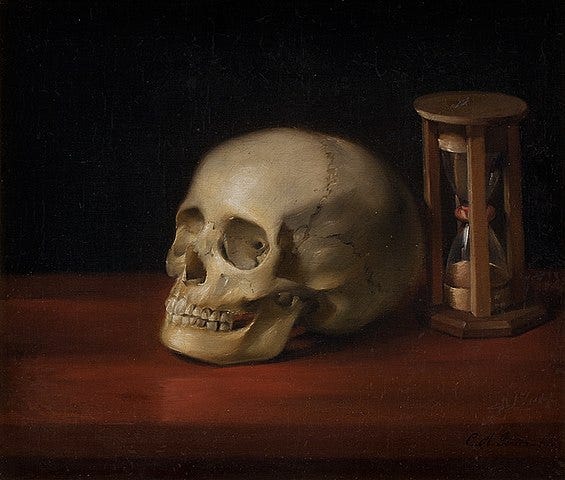
“Stench and worms.”
To use Leo Tolstoy’s words in A Confession, that’s what will become of us all after death. We toil through life. Our actions will inevitably come to an end. And all memory of us will eventually disappear. So, what’s the point of going on in the first place? Why do anything at all? Why live?
At the age of thirty-two, these questions plunged me into an existential crisis — a period of doubt about the value of my very existence given the inevitability of my demise. Did a fulfilling life simply mean checking off all the boxes? Or was there a deeper meaning to my finite time on Earth? If the latter was true, I had to confront the promises I’d been handed down from my society since childhood. My teachers and family had encouraged me to focus on professional success, and my culture added that a romantic relationship, solid friendships, and community would seal the deal. This was not a late “quarter-life crisis” about which careers or interpersonal connections to cultivate. No, what bothered me was death itself. Did any career or relationship matter in the face of it? To understand whether life was worth living, I now needed to grapple with my mortality.
My instinct as a philosophy professor was to dig into works on the meaning of life. I had received a Ph.D. in the field three years earlier, and during my final year as a graduate teaching assistant, I’d helped with a course on the meaning of life. Although my academic research was about feminism and the philosophy of race, I knew I had the tools to solve my predicament. So that’s how I found myself on a journey through the history of literature, psychology, and philosophy to answer my doubts about life’s worthwhileness. From August 2018 to June 2019, I woke up at 6 o’clock nearly every morning to pore over dozens of texts on the meaning of life.
Throughout my quest to understand why life was worth living, I found hints of answer in many places: Friedrich Nietzsche; the contemporary philosophers Susan Wolf and Lars Svendsen; Hubert Dreyfus and Sean Kelly’s study of Western literature and nihilism; Victor Frankl’s famous Man’s Search for Meaning; and the psychiatrist Irvin Yalom’s massive Existential Psychotherapy (yes, I did read all five-hundred twenty-four pages). While all these readings shed light on my existential preoccupations, three works stood out along the way. They each articulate a different path toward understanding why life is worth living, and I recommend them to anyone who is seeking to answer this question.
Leo Tolstoy: The Religious Path
My first stop was Leo Tolstoy. By his fifties, he enjoyed world fame and lived a comfortable life. Still, his accomplishments began to feel hollow to him. Why care about them if they’ll eventually disappear from human memory? What was the purpose of carrying on if his life and legacy would come to nothing? These questions grew from occasional disruptions in his daily life to a years-long period of torment. Within the first pages of A Confession, the story of this crisis, I knew I’d found someone who understood my existential worries.
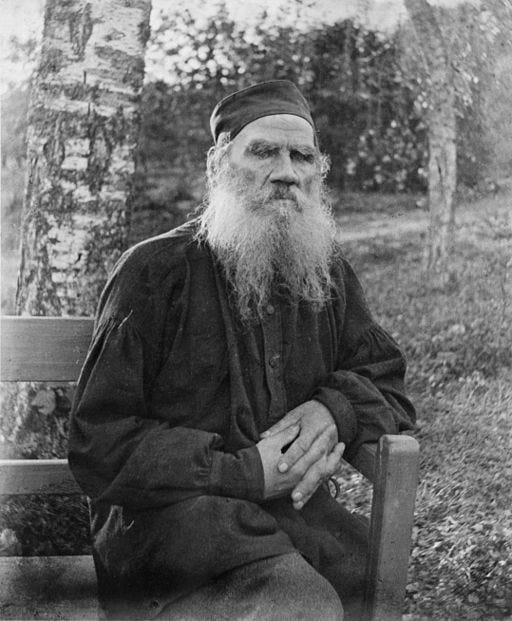
To respond to the question of life’s purpose, Tolstoy studied many fields — from the experimental sciences all the way to metaphysics. But they proved useless. Every single one. Take biology. All it could say was that he was a “transitory, casual cohesion of particles.” A bit disheartening for anyone who wants their legacy to live on or believes that the universe has assigned a destiny to them. And metaphysics only gave nonsensical answers, to the effect that “the world is something infinite and incomprehensible” and that “human life is an incomprehensible part of that incomprehensible ‘all.’” Hardly helpful if you hope to comprehend the world and your place in it.
Tolstoy also looked to his immediate circle of friends and acquaintances to see his way out. But again, to no use. The people in his social class seemed to be either dilettantes or empty souls who didn’t dare to own up to the meaninglessness of their lives.
His failed attempts to shore up his will to live brought him to the verge of death. Yet, he couldn’t bring himself to take his own life. Since he couldn’t find reasons to live in the sciences or from those around him and felt he shouldn’t take his life, he needed to look further:
“I instinctively felt that if I wished to live and understand the meaning of life, I must seek this meaning not among those who have lost it and wish to kill themselves, but among those milliards of the past and the present who make life and who support the burden of their own lives and of ours also.”
Beyond his immediate circle were Russian peasants, who, supported by their Christian faith, never seemed to question whether life was worth living. This epiphany led Tolstoy to God. Although he was surely romanticizing the life of the peasantry, he identified what was, to him, a philosophical truth: the only way to find a finite life worth living was to have faith in being united with something infinite after death. To aspire to such a union, one must live according to God’s law. So, not only did faith teach Tolstoy why to live, but it had the bonus of telling him how to live.
I admired Tolstoy’s intellectual honesty in describing his crisis and religious solution to it. But because of my secular upbringing, I couldn’t quite accept his conclusion. I felt disconnected from Christianity, the faith of a few family members. Too many years spent with atheist friends, irreverent philosophy professors, and Nietzsche had turned me off from religion. I’d been curious about Buddhist teachings for their philosophical insights on happiness, but other aspects of the religion, such as the belief in reincarnation, made me pause. Instead, A Confession inspired me to seek a solution of my own.
Albert Camus: The Atheistic Path
Ten months into my 6 A.M. risings and readings, I stopped at a promising text, Albert Camus’s best-known work, The Myth of Sisyphus. Whereas A Confession describes a personal struggle with the question of life’s purpose, The Myth of Sisyphus, as a philosophical work, offers a general answer to this question.
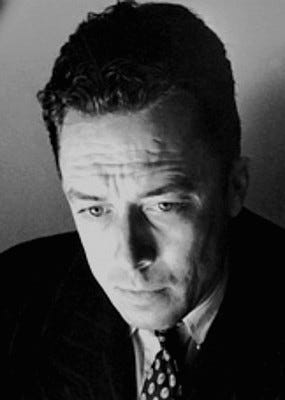
Camus begins by asking us to acknowledge that the world is irrational: there are limits to what we can understand about it, including the reasons why any of us is even here. That’s what he calls the “absurd” — the “conflict” between the irrationality of the world and “the wild longing for clarity whose call echoes in the human heart.” According to his philosophy of the absurd, we shouldn’t hope for a grand answer about our purpose on Earth, and we shouldn’t believe that something eternal would redeem our time here. Rebel against the hope for a capital “M” meaning to our lives! Reject the consolations of religion!
Camus’s call to action sounded catchy, but I couldn’t see a clearly defined argument. Even if I’d dismissed Tolstoy, I could still grasp his defense of religious faith: our finite lives are worth living because they can be redeemed by something infinite, namely, God. By contrast, Camus’s argument for finding life worth living seemed to be a compilation of suggestive but unpersuasive images. For example, he uses the “the conqueror” figure as a model for living in an absurd world; this is someone who lives in the moment, for the sake of his victories, and not for any further purpose. But what’s so satisfying about conquering anything if there’s no ultimate justification for one’s conquests or if there’s no care for their longevity? I didn’t see any satisfactory responses to my worries in the text. Or take the final allegory of the book, which gives it its title. Sisyphus is a man condemned by the gods to roll a rock up a hill before seeing it fall back down, then to roll it back up again before seeing it fall back down — forever. For Camus, Sisyphus’s fate is like ours. There’s no reward for his task, just as there’s nothing that compensates our Earthly toils. Somehow, though, Camus is optimistic about his “absurd hero”: “This universe henceforth without a master seems to him neither sterile nor futile.” Why? Because Sisyphus can adopt his attitude toward his fate. The correct choice — the path to happiness — is to embrace it. Hence the iconic closing line: “One must imagine Sisyphus happy.”
Camus’s solution, the opposite of Tolstoy’s, had the advantage for me of sketching a secular path out of my worries. But, as I joked to friends and students, I could not imagine Sisyphus happy! The image of his empty labors horrified me instead of helping me find life worth living, and his text raised more questions than answers. Why should scorning the absence of a grand meaning to life motivate us to go on? Why doesn’t “lucidity” about our fate lead to the exact opposite of happiness? As the scholar Ronald Aronson says, Camus’s argument that the absurd hero’s existence is better than one supported by religion “reveals a certain sleight of hand, as the philosopher gives way to the artist.”
Although Camus’s portraits of absurd living failed to compel me, I felt that there was a kernel of truth in his work — the idea that we shouldn’t stake our lives’ meaning on the possibility of heavenly bliss. Ever since reading the philosopher Simone de Beauvoir’s description of losing religious faith, I’d become convinced that this life mattered more to me than anything else. Even if it existed, to hell with the afterlife!
William James: The Spiritual Path
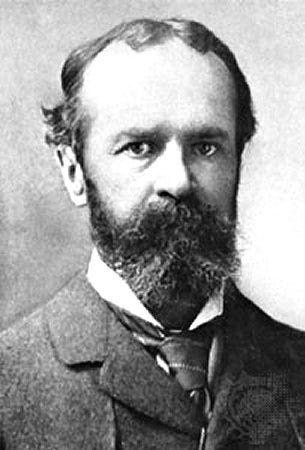
A week after finishing Camus, out of ideas, I googled, “Is life worth living?” After months spent bleary-eyed and hunched over stacks of books that only offered half-answers, it was the best I could muster. But that’s how I stumbled on William James’s 1895 address to the Harvard YMCA, “Is Life Worth Living?”
James begins with a humorous response to the question: “It depends on the liver.” But there’s no joking around in his talk. He was speaking to the ruminators in his audience who worry that there’s no purpose in living:
“Many of you are students of philosophy, and have already felt in your own persons the skepticism and unreality that too much grubbing in the abstract roots of things will breed…. Too much questioning and too little active responsibility lead…to the edge of the slope, at the bottom of which lie pessimism and the nightmare…view of life.”
He was speaking to me.
To answer the question of life’s meaning, he appeals to religion, but in an unorthodox way. The view that the world is perfectly ordered by a divine being seems false, given all the contradictions we behold daily: joy and sorrow, birth and death, beauty and ugliness, and so on. No point believing in a grand architect on that count. Plus, based on scientific considerations, such as evolutionary theory, James dismisses the idea that there must be a “divine watchmaker” to account for the workings of nature.
Instead, for him, religion simply signifies believing in something beyond the senses — an unseen or supernatural order — that would give meaning to our efforts. Here’s one of his analogies to illustrate the point. Consider a dog who’s subject to a medical experiment to find a cure for a human or animal disease. While the dog may not understand the broader context of his suffering, this suffering does serve a larger purpose. Likewise, humans may live in an unseen realm where their struggles have a broader significance.
The crux of his argument is this: there’s nothing wrong with choosing to believe in a supernatural order, even if there’s no guarantee that it exists. Those bent on “hard facts” deny that there’s a world beyond the senses, but at the same time, they have to admit that there’s no proof that such a world does not exist. So, which option — religion or skepticism — is the best? For James, the advantage of religion is pragmatic. Hoping that there’s a grand scheme of things can encourage you to act in this life. Your contributions may extend beyond your finite existence.
Ultimately, the most penetrating part of James’s text was his concluding metaphor. Imagine that you’re mountain climbing and reach a dangerous pass. You have no option but to leap across it to continue on your way. James says that you’re more likely to find your footing if you gather the courage to take the leap, rather than waffling and waffling about whether you can land safely. So too, you should strive to make your life worth living instead of fussing over death, evil, and all the contradictions in the human condition. Leap into the activities that give you a “why” to live for! Wasn’t that image better motivation than Sisyphus defiantly rolling a rock up a hill and seeing it fall back down forever and ever?
At its core, James tells us that you shouldn’t wait for proof that life is worth living. Rather, you should fight to make it so: “Be not afraid of life. Believe that life is worth living, and your belief will help create the fact.”
As queasy as religion had once made me feel, I had found something in James. Although he spoke of religion, calling his ideas “spiritual,” rather than “religious,” made me feel more comfortable. Unlike Tolstoy, a meaningful life didn’t imply obeying a divine law that would guarantee a union with God. And Camus’s atheistic position hadn’t helped me.
James’s defense of faith, of all the arguments I considered, was the most compelling. The unseen order that would give meaning to my daily struggles was only a “maybe.” Yet didn’t I act on “maybes” every day? Didn’t I prepare for teaching even if I could be hit by a car on the way to class? If I worried about every possible accident, I’d never get up in the morning. “Believe that life is worth living” meant more to me than the philosophical equivalent of Nike’s “Just do it.” James called on me to take action, thanks to the sliver of hope that my contributions wouldn’t be negated by my death.
My reading of James’s lecture closed my odyssey. My life was worth living — despite its finitude. The text cured me of my existential worries, but I doubt that I would have learned from it had I not first pondered Tolstoy’s and Camus’s solutions. Although it may be less known than either A Confession or The Myth of Sisyphus, “Is Life Worth Living?” proved to be invaluable. James bravely dives into the question of life’s worthwhileness in the face of death. And perhaps because the text was originally an address, his style is deeply personal and moving. But more than anything, what was so powerful was that his argument carved a middle ground between traditionally religious and atheistic responses to my crisis.
James has marked me — for life. I’ve shared his address with friends, and it became the impetus for a course that I now teach at my university on the philosophy of death. “Believe that life is worth living, and your belief will help create the fact” has taken root in my psyche. I repeat the phrase like a mantra whenever I question the purpose of my finite existence.
By the age of thirty-two, none of the everyday advice I’d received about work or relationships could help me find life fulfilling. What I needed was a broader examination of its meaning. What I needed was the hope that I wasn’t a mere cog in the machinery of the universe — temporary and devoid of significance. Thanks to James, I was reminded to contribute to humanity — whether in my private life or simply by sharing my journey to answer the question, why live?