
Daniel Muñoz
Philosophy is just a few clicks away!

What is philosophy to you?
Philosophy is where you end up after repeatedly clicking the first link on Wikipedia.
For example, if you start at the page for pain au chocolat (my favorite pastry), the first link will take you to the page for “France,” which leads to “Western Europe,” then plain “Europe,” then “Continent,” followed by “Convention (norm).” From there, it’s a mere 14 steps to “Philosophy” itself.
There is probably no intellectual pursuit with a wider basin of attraction. So many subjects can be seen as gateways to philosophy—or the reverse!
As someone whose mind is always wandering, perhaps it was inevitable I’d wind up a philosopher, given sufficient time. And what a joy to be able to branch out into other subfields, or even into other disciplines (though here the learning curve is steeper). I never know what I’ll be studying in five years. It’s exhilarating.
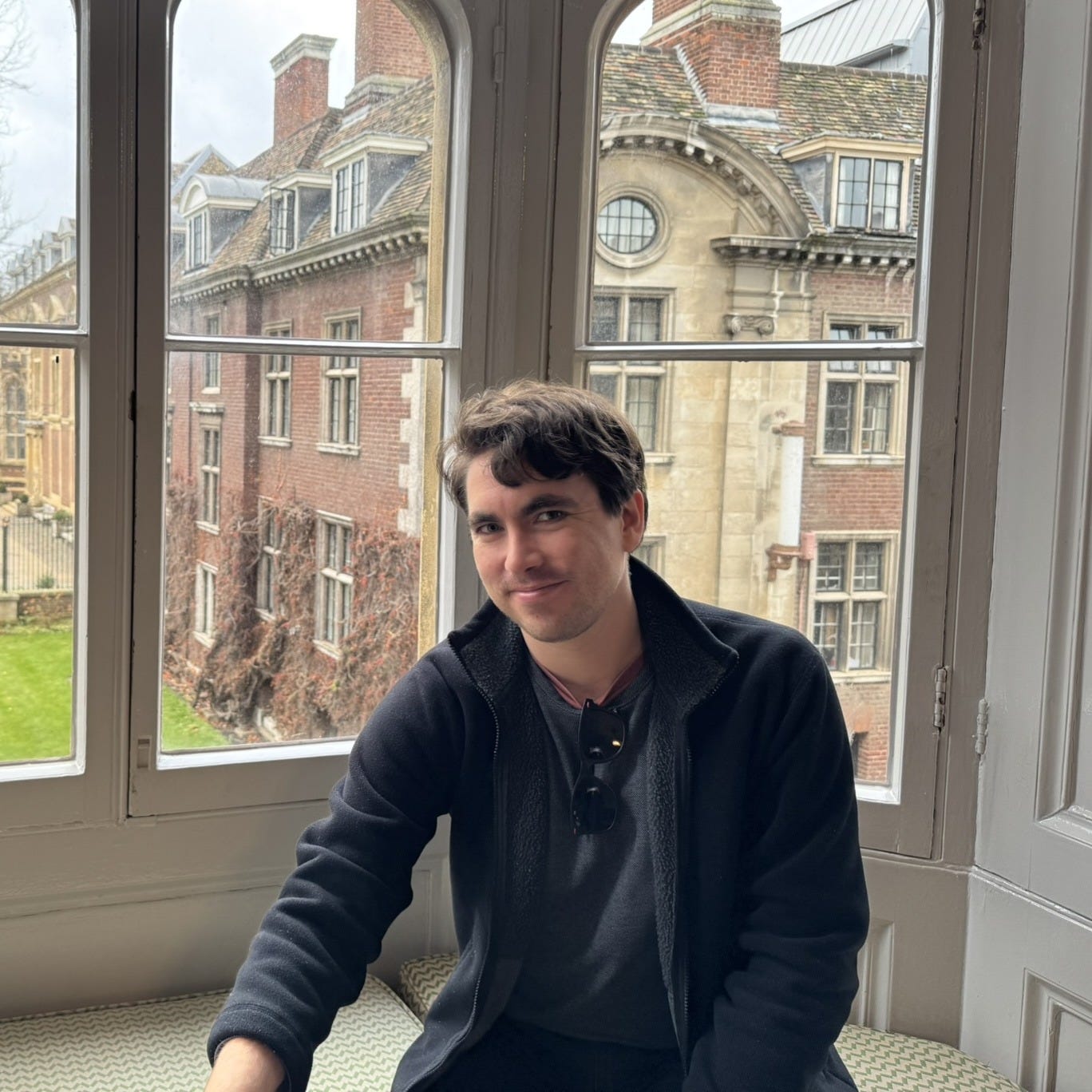
How were you first introduced to philosophy?
My high school offered philosophy classes, but I never took them. I was mostly reading philosophy on my own, the way I was teaching myself the guitar. I would talk for hours and hours with my friends, particularly Erik Shoener and Travis Smith (we were also in a band). Coincidentally, the three of us met up as a trio for the first time in over 10 years just yesterday in Chinatown in Los Angeles. Music and philosophy bond people together like that, I suppose.
The first question to really grab me was that of the existence of God. I was a devout child, to the point where I stuck out as an unworldly goody-two-shoes. When I started learning about science and philosophy at age 11, I experienced a crisis of faith. I had been taught by the Baptist fundamentalists at Plano Kids & Teens that humans didn’t evolve from other primates. That the devil had put dinosaur fossils in the ground to fool us. You can imagine the betrayal I felt after learning some basic biology. (The same adults, by the way, had forbidden me from reading Harry Potter books or dressing up for Halloween. Rebellion was inevitable.)
To be honest, when I first got to UT Austin, I remember being intellectually arrogant. Thankfully, that phase didn’t last too long (or so I hope). In my second term, I took Jonathan Dancy’s Ethical Theories class, which taught me in spectacular fashion how little I knew—about how to read, how to write, how to argue. For me, this was the right lesson at the right time. I needed to be okay with the vastness of my own ignorance. I needed to get my ego out of the way and reconnect with the unselfconscious feeling of wonder that had first drawn me into philosophy.
How do you practice philosophy today?
When I look back on my time as a student, I’m in awe. There was just so much free time, so many unclaimed hours to wander around, talk philosophy with friends, and read whatever I felt like. (Even when I was vacuuming the carpets at Mi Cocina as a busboy over the summer, I could think about moral particularism or whatever else I’d be reading about as soon as I got home.)
Now, my relationship with philosophy is much more tightly regimented and prescribed. I teach classes, advise graduate students, write papers I’ve promised to write, update pieces I’ve promised to update, upload letters of recommendation to various portals, edit book reviews, review various journal articles, grant proposals, and book proposals, etc.
But just as married couples carve out time for date night, I try to make time for reading and writing philosophy purely for the love of it. Lately, that’s meant reading the classics of political philosophy (especially Hobbes, Locke, and Hume), along with some social science (Elinor Ostrom) and more recent interdisciplinary work (Joe Heath). It’s a delight.
And now I have an outlet for my labors of love. Instead of turning everything into journal articles (a worthwhile but time-consuming process), I put out roughly a post a week on my Substack, Big iff True. That has ended up being its own portal into another world. I’ve met real-life friends there (such as Darby Saxbe), and now I wonder if Substack is where I have the most surface area.
What is a philosophical issue that is important to you?
How do we live with people whose worldviews we fundamentally reject?
It’s easy to underrate the depths of our disagreement. Americans, for example, disagree about the existence of God, the nature of the afterlife, and the foundations of morality; we disagree about who won the 2020 election, whether vaccines and Tylenol cause autism, whether rent control helps renters, and whether immigrants add to or detract from our economy. There is just no prospect of settling all of these disagreements permanently. Sometimes you’ll catch people fantasizing about “education” as the solution—usually this exaggerates the effects of education reform (and underrates the difficulty).
I started out as an ethicist, not a political philosopher. But thinking about ethics naturally led me to think about rights, and learning about rights naturally led me to appreciate the value of a “live and let live” ethos in a pluralistic society. This interest in political pluralism has also, rather happily, come to dovetail with my interest in multidimensional value. But now I’m wandering.
What books, podcasts, or other media have stood out to you as a philosopher?
Thomas Schelling’s The Strategy of Conflict instantly changed my life. So did Robert Axelrod’s The Evolution of Cooperation, which I’ve read maybe six times. Amartya Sen’s Collective Choice and Social Welfare is probably the single book I’d most strongly recommend to a graduate student in moral philosophy who wants to branch out intellectually. My favorite ethics book is Judith Jarvis Thomson’s Rights, Restitution, and Risk.
As for other media, Jerusalem Demsas has put together a phenomenal team at The Argument, where she and Kelsey Piper have been on a tear. Jared Henderson is doing great things at Commonplace Philosophy. I’m a loyal reader of Why Philosophy? (so it’s a treat to be on the other side of the screen).
Finally, I have to shout out some online lectures. Ian Shapiro’s Power and Politics class from 2019 is a gold mine—probably the single biggest intellectual influence on me post-graduation. Marginal Revolution University is brilliant. David Blight’s lectures on the Civil War and Reconstruction are works of art—my wife and I will put them on when we’re on a road trip. I love the way Blight weaves in poetry and contemporaneous letters. If you haven’t heard David Blight perform Langston Hughes, do yourself a favor and get thee to YouTube.
Daniel Muñoz is a moral philosopher with interests in politics, economics, and formal methods. His first book, co-authored with Sarah Stroud, is Ethical Theory: 50 Puzzles, Paradoxes, and Thought Experiments (Routledge, 2024). Next up is What We Owe to Ourselves (under contract with Oxford UP). He’s written papers about freedom, rights, the nonfungible value of a life, and the difficulty of combining multiple values into a single decision.
Officially, he’s Associate Professor of Philosophy at the University of North Carolina at Chapel Hill, where he’s also Core Faculty in Philosophy, Politics, and Economics (PPE). He writes about PPE and current events on his Substack, Big iff True.
 | A guest post by
|
Love this interview - so great to hear more about your origin story!
Enjoyed reading this! Rights, Restitution, and Risk is one of my very favorites too