
Addison Ellis
Philosophy and the Pursuit of Self-Knowledge
What is philosophy to you?
There is a kernel of truth in many of the most common ways of defining philosophy. I agree that philosophy has something to do with, as Sellars put it, “how things in the broadest possible sense of the term hang together in the broadest possible sense of the term.” But I also agree with those who characterize philosophy as a way of living or approaching one’s everyday life. What enables us to think of it in both ways, perhaps, is a thought shared by Plato, Aristotle, and Kant, among others: that philosophy begins in and is sustained by a sense of wonder (thauma for the Greeks, “Bewunderung” for Kant).
For Kant, that life spring of philosophy is the awe and admiration that compels us to search for an ultimate ground even when we know the impossibility of discovering one. Even turning to objects that we know, we find something ultimately inexplicable which compels our reason further (e.g., Critique of the Power of Judgment, 5: 364-65). The wonder that drives reason to systematize all of knowledge reflects reason’s pursuit to know itself, our pursuit of self-comprehension. This should stand out in contrast with a contemporary tendency to treat philosophy as a set of special topics studied by scholars with special interests.
How were you first introduced to philosophy?
I always craved books, films, and music that would make me feel something very deeply. As a child, I already had some kind of nostalgic personality, and I think that lends itself naturally to developing into a philosopher. I suspect there is something right in Novalis’s idea that philosophy is like homesickness. Even if Kant is right that reason can achieve a kind of peace in knowing its own limits, this must somehow involve recognizing the inexhaustible need to search for completeness. One can find this desire for finding the way back home in much of the history of philosophy, from Plato’s anamnesis to Heidegger’s account of temporality.
As an adolescent, that cast of mind carried me further into literature that gave me the sense that reflection and writing could express the most fundamental truths. That didn’t fully blossom until I began trying to read philosophy for real. After carrying around a copy of Beyond Good and Evil for a while, one of my teachers suggested that I read his father’s book on Nietzsche (that happened to be a book by Richard Schacht, recommended by Marshall Schacht). Once I learned that I could study these texts with experts, I resolved to do just that. I kept an open mind at first about what to dedicate my studies to, but it quickly became concentrated on philosophy.
How do you practice philosophy today?
I agree with the tradition according to which philosophy concerns itself primarily with what reason produces from itself. In the Kantian formulation of this thesis, what reason produces from itself is the form of all knowledge. However, while this form can be investigated on its own terms, it may be used only in determining some content, hence Kant’s famous remark that “Thoughts without content are empty, intuitions without concepts are blind” (Critique of Pure Reason, A51/B75). While this form-matter relationship is perhaps more complicated in Kant’s practical philosophy, where the object is also made actual through reason, there too it remains true that knowledge is an act of in-forming some matter. Reason is not tethered to any given way of life but must form for itself a life.
Now returning to something I mentioned before: the wonder expressed in reason’s pursuit of self-comprehension is not entirely separable from concrete ways of encountering that wonder in life. While reason might wonder, for example, at the thought that there is anything at all, such a question will arise only from something we in fact know about the world—i.e., in the determination of nature itself.
So, on the one hand, my way of practicing philosophy today contains a “formal” strand which consists in reflecting on the form of reason itself. This most clearly requires the kind of study embodied in academic writing and teaching. But, on the other hand, that formal strand has significance only as it determines the matter of a life. I think it is in realizing this that we become fascinated by forms of self-understanding that are embodied in media such as film, literature, and music. For this reason, I find it impossible to think of my philosophical practice as confined within a professional life, and I do think of philosophical thought broadly enough so as to encompass modes of “reflection” that may be quite subtle or implicit, often taking on the form of an aesthetic practice.
What is a philosophical issue that is important to you?
I mentioned that I think the guiding principle of philosophy is self-knowledge. For me, the most important issue has been to understand the self-determining character of this activity (what Kant calls spontaneity). So, a persistent dimension of my work is to work out exactly what this means and what it entails for philosophy as a whole.
But, drawing on what I just mentioned about artistic practices, I am also increasingly interested in how our need for self-comprehension is expressed concretely in distinctively temporal ways. Film, for example, is a way of opening up the world to ourselves. We might think of it as a very natural (perhaps even historically inevitable?) way of reckoning with what it means to have an image of the world. And this takes place by synthesizing images, whether in narrative or non-narrative ways. That practice of bringing a kind of shape to images is fundamentally a reflection on how our images exist in time. I am therefore interested in the idea that film is an indispensable mode of reflection on how we exist in time.
What books, podcasts, or other media have stood out to you as a philosopher?
While so many spring to mind, I will name just a few things that coalesce around the themes I’ve mentioned.
I always return to Alfred Hitchcock’s Vertigo (1958) and Stanley Kubrick’s The Shining (1980) as reflections on what it could mean for self-understanding to gain a determinate temporal orientation. In these films, the past (and even pastness, in ways that belong to us individually and supra-individually) is reckoned with as something which haunts but also calls and enables us. There is also fertile ground here for reflection on the temporal character of human nature itself, and particularly how things like evil or vice have a past.
I recommend listening to the great actor Harry Dean Stanton’s rendition of José López Alavez’s “Canción Mixteca” (a version of which was also featured in the Wim Wenders film Paris, Texas). Here, there is a fascinating reflection by Stanton on how a song can embody the need to return home.
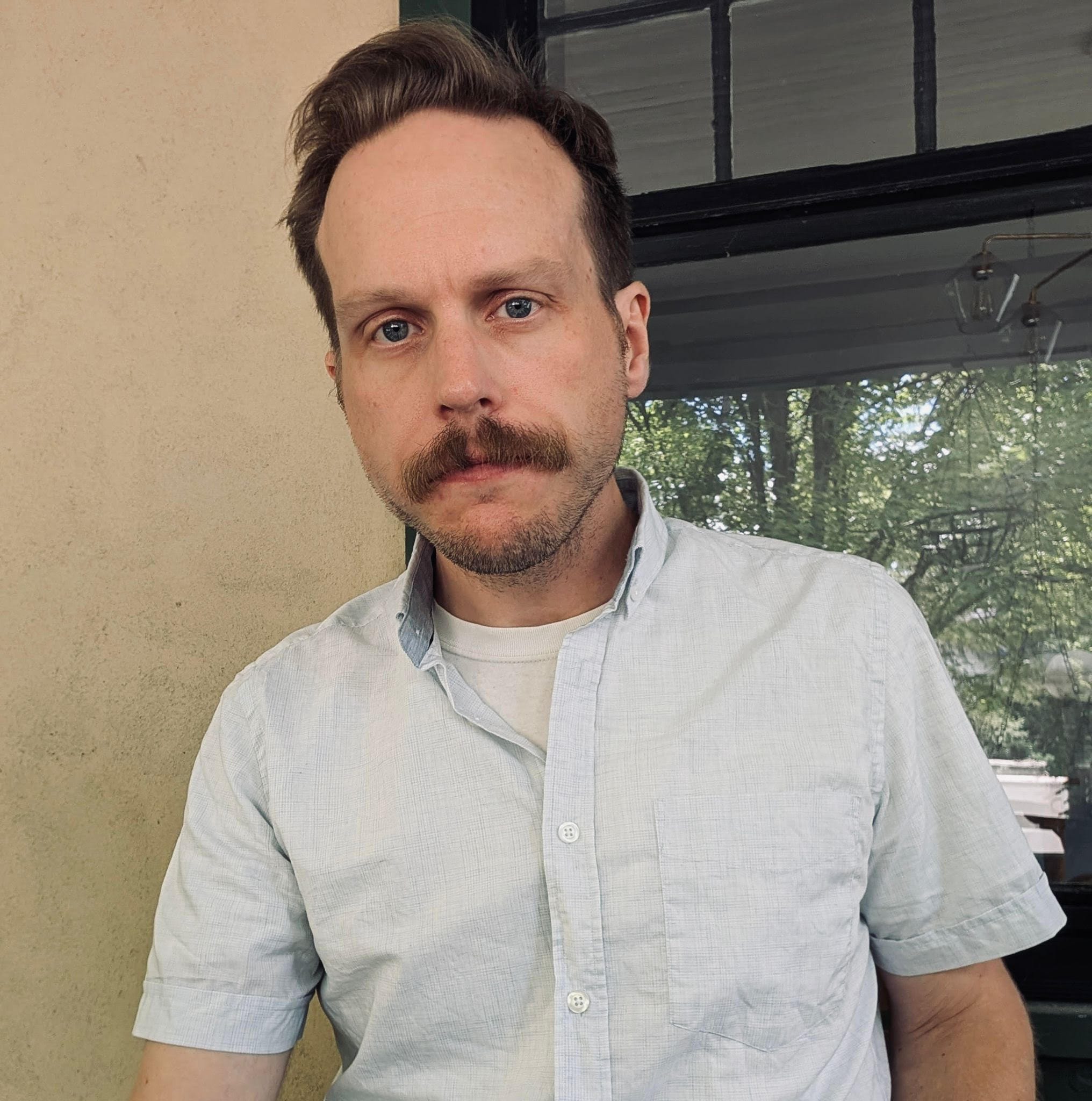
Addison Ellis is an Assistant Professor of Philosophy at The American University in Cairo. After receiving his PhD from the University of Illinois at Urbana-Champaign in 2019, he was a postdoctoral research fellow at the Universidad Nacional Autónoma de México (UNAM) in Mexico City, and then a lecturer at the University of Illinois. His research focuses on Kant and post-Kantian European philosophy up through existentialism. Within these areas, Addison thinks about the significance of self-consciousness and what Kant describes as its “spontaneity.” He is particularly interested in how these themes appear not only in Kant’s theoretical philosophy, but also in his practical and religious thought, and more broadly, how these ideas are taken up, transformed, or rejected by the post-Kantian tradition. Recently, he has also been thinking more about these topics in relation to philosophy and film.
I was particularly struck by the idea of philosophy as a kind of homesickness. Perhaps many of our questions are, in the end, attempts to find our way home—not necessarily to a place, but to a deeper understanding of who we are.
Really interesting!